




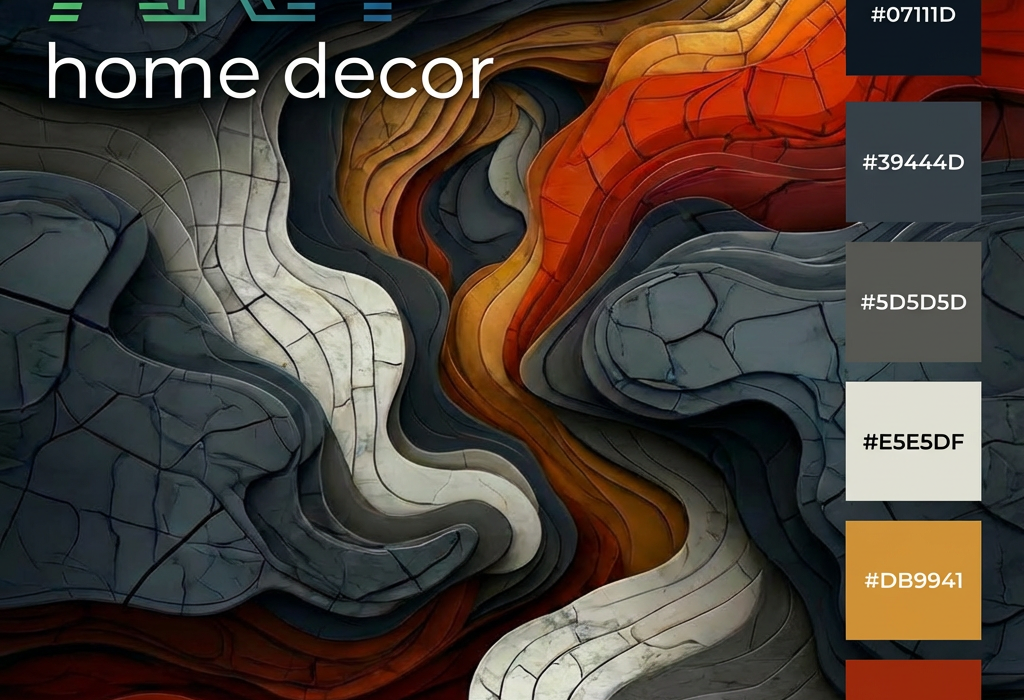
How Words Turn into Art: A Deep Dive into an AI Image Generation Prompt
In the sophisticated world of AI image generation, the magic lies not just in the model itself, but in the precision and quality of the “prompt” we provide. A prompt is more than a command; it’s a detailed artistic recipe that guides the AI to create a visual masterpiece. Let’s take the following prompt as an example and break it down, step-by-step, to understand the secret to its power.
Table Of Content
- How Words Turn into Art: A Deep Dive into an AI Image Generation Prompt
- Part One: Defining the Foundation – Subject and Style
- Part Two: Adding Texture and Depth – Materials and Formation
- Part Three: The Precision of Color – The Specified Palette
- Part Four: The Finishing Touches – Composition and Quality
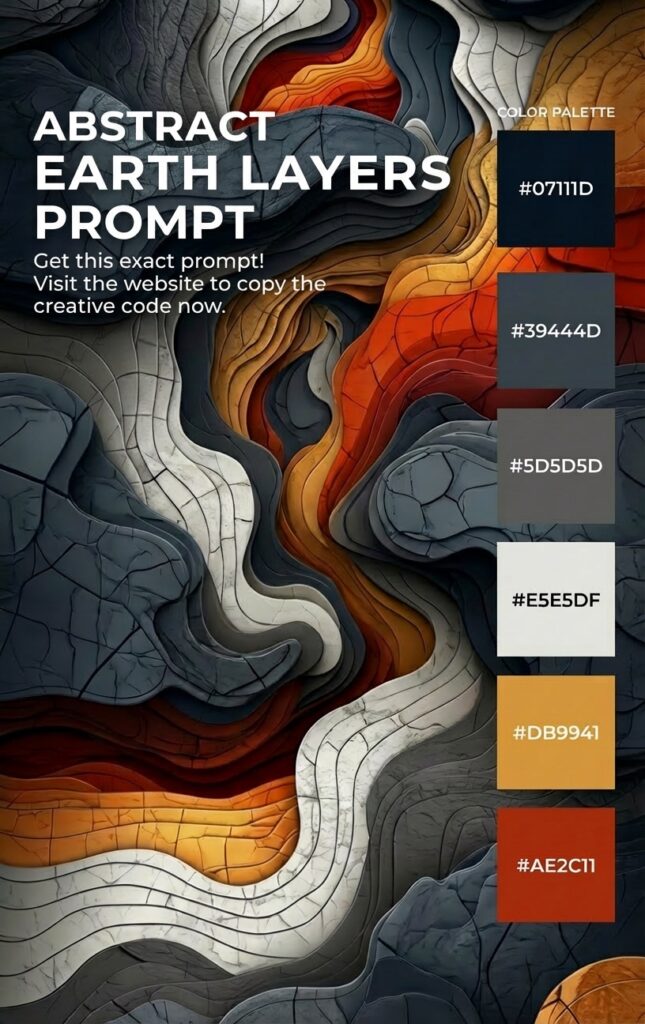
“A hyper-realistic 3D abstract digital art of flowing, layered organic shapes. The textures are a mix of cracked stone and smooth terrestrial surfaces, creating a sense of depth and geological formation. The color palette is strictly deep navy blue (#07111D), dark slate grey (#39444D), medium grey (#5D5D5D), light off-white (#E5E5DF), muted mustard yellow (#DB9941), and rich burnt orange (#AE2C11). Dynamic composition, intricate details, 4K resolution.”
Part One: Defining the Foundation – Subject and Style
“A hyper-realistic 3D abstract digital art of flowing, layered organic shapes“
Here, we lay the cornerstone of the image. Every word plays a crucial role:
| Word/Phrase | Its Role in Directing the AI |
|---|---|
| Hyper-realistic | This commands the model to strive for the highest level of realism, avoiding cartoonish or overly simplistic styles. The goal is to make the image look like a tangible object. |
| 3D | This specifies that the work must be three-dimensional, implying depth, shadows, and lighting that suggest volume and form. |
| Abstract digital art | This clarifies that the work is not a representation of something real (like a person or a car), but rather a non-representational piece based on form and color. |
| Flowing, layered organic shapes | This describes the nature of the shapes themselves. “Flowing” and “Organic” mean they are not sharp or geometric, but soft and nature-inspired. “Layered” instructs the AI to stack these shapes, which immediately adds visual depth. |
Part Two: Adding Texture and Depth – Materials and Formation
“The textures are a mix of cracked stone and smooth terrestrial surfaces, creating a sense of depth and geological formation.”
This part gives the image its unique “soul” and texture.
| Word/Phrase | Its Role in Directing the AI |
|---|---|
| A mix of cracked stone and smooth surfaces | Here, we define the materials. Combining “cracked stone” with “smooth surfaces” creates a wonderful visual contrast that keeps the eye engaged and moving across the image. |
| Creating a sense of depth and geological formation | This phrase doesn’t just describe what to see, but the desired effect. It directs the AI to arrange these textures in a way that feels like a natural geological formation, such as sedimentary rock layers. |
Part Three: The Precision of Color – The Specified Palette
“The color palette is strictly deep navy blue (#07111D), dark slate grey (#39444D)…”
This section is one of the most critical secrets to a professional prompt: absolute precision.
| Word/Phrase | Its Role in Directing the AI |
|---|---|
| Strictly | A powerful word that means “exclusively.” It prevents the AI from introducing any other colors, ensuring complete adherence to the desired color scheme. |
| Descriptive names & Hex Codes | Using descriptive color names (like “deep navy blue”) along with their Hex Codes (like #07111D) removes all ambiguity. The AI might interpret “dark blue” in various ways, but a hex code is a universal and precise language it understands perfectly. |
Part Four: The Finishing Touches – Composition and Quality
“Dynamic composition, intricate details, 4K resolution”
These are the final instructions that elevate the image from “good” to “stunning.”
| Word/Phrase | Its Role in Directing the AI |
|---|---|
| Dynamic composition | This asks for a visual arrangement that has movement and life, rather than a static, boring design. It encourages the use of curves and diagonal lines. |
| Intricate details | This pushes the model to add fine, complex details, making the image rich to explore when zoomed in and visually captivating. |
| 4K resolution | This specifies the final output quality. It ensures the image is high-definition, sharp, and suitable for professional use cases like posting on Pinterest or printing. |

No Comment! Be the first one.